

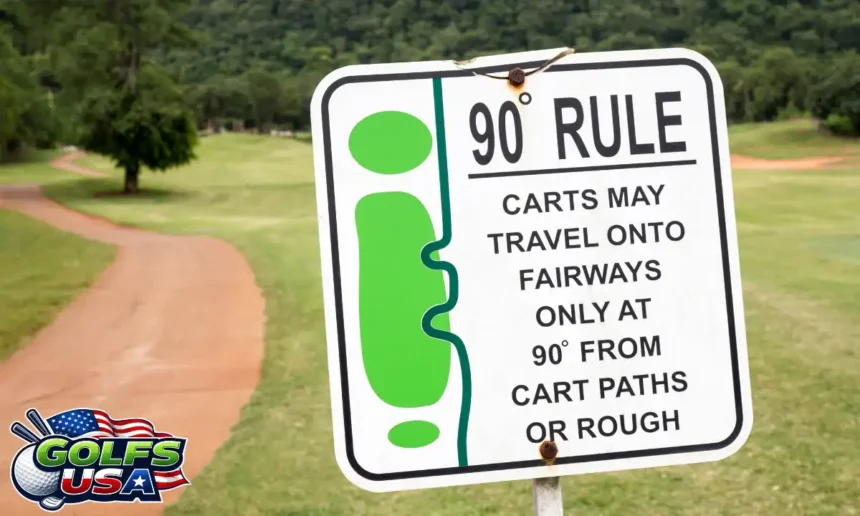
When What Is the 90% Rule in Golf when mentioned by golfers refers to 90% rule of golf carts where a golfer will have to keep his golf cart on the cart path until he comes to a position level with his ball, then he will make a 90-degree turn and drive straight to it and go back to the cart path the same way. This is a course policy aimed at protecting the turf and not a Rule of Golf.
There is another area where the term might refer to which is the 90% handicap allowance in four-ball match play, and this will be discussed below also. However, if you notice a sign on the first tee or a statement on your scorecard, the 90% rule of golf is the cart rule and this guide will explain how exactly to abide by this rule, why courses implement this rule, and what errors might result in getting a talking-to by the marshal.
The Short Version
| Question | Answer |
|---|---|
| What is it? | The 90-degree cart rule, which limits how carts drive on the fairway |
| How it works | Stay on the path until level with your ball, turn 90 degrees, drive straight to the ball, then return the same way |
| Why courses use it | To protect the turf from wear, compaction and tire damage |
| Is it in the Rules of Golf? | No. It is a local course policy |
| Is there a penalty? | No stroke penalty, but the course can take your cart away or ask you to leave |
| When is it used? | Often after rain, in wet seasons, or on courses protecting fairway condition year-round |
| Stricter version | Cart path only, where carts never leave the path |
| The other 90% | In handicap competitions, 90% of Course Handicap is the recommended allowance for four-ball match play |
How the 90-Degree Rule Works
The basic premise of the rule is to make sure that the golf cart is kept on the fairway for the shortest time possible and to make sure that the points of access are distributed evenly and not worn through in the middle.
How the process goes: drive on the cart path and position yourself so that your ball is perfectly perpendicular to the cart path. Go off the path and drive straight up to the ball. Take your shot. Drive straight away from the ball back onto the path. And repeat for all other balls.
It’s the direct approach in and direct approach out that matters. Any angling across the fairway towards your ball or driving off to pick up a playing partner is precisely what the rule is meant to stop, prevent, even if it feels quicker.
A Hole Played Under the 90-Degree Rule
Let’s say you and your partner are riding together in a cart. Your drive ends on the left hand side of the fairway and his/her’s is 30 yards ahead, on the right hand side.
You drive along the path to the point that is even with your ball, make a right angle turn and step out. After hitting your shot, you do not drive along the diagonal to the other ball but come back to the path and continue following it until you get even with the second ball, making a right angle turn again. It is a shorter distance, two turns as opposed to a diagonal line and time saving ride.
In case the balls are on opposite sides of the fairway, the quickest way to approach them is to drop the partner with a few clubs, drive to the second ball and have him/her walk back to meet you.
Why Courses Use the 90-Degree Rule
The average weight of a cart loaded with a golf player is 1,000 pounds, and a bustling golf course moves 200 such carts over the fairways everyday. What the damage is not, is the tire marks visible on the surface. The damage is compaction, where the soil is devoid of air pockets, inhibiting root growth. Also, it leaves patches that are thin, hard and need long recovery time.
The wet soil aggravates all this, thus this rule applies predominantly when there is rainfall or during rainy periods. The rule allows distribution of the cart movement around the entire hole, by making the cart enter and exit from different points.
Finally, the rule has a personal motive of applying it as well. Such patches become difficult lies for golfing, and the golfer who takes shortcuts in the cart in March becomes the one who plays off hardpan in July.
Cart Policies You Will See on Course
| Policy | What it means | When it is used |
|---|---|---|
| Carts anywhere, or scatter | You can drive on the fairway freely, keeping clear of greens, tees and hazards | Dry conditions and courses with hardy turf |
| 90-degree rule | Path until level with the ball, then straight in and straight out | Damp or recovering turf where some access is still fine |
| Cart path only | Carts never leave the path at all | Heavy rain, frost recovery, aeration or winter play |
| Path only on par 3s | Short holes get extra protection because of concentrated traffic | Common year-round at many courses |
| Ropes and stakes | Marked areas are closed to carts entirely, whatever the day’s policy | Around greens, tees, bunker surrounds and worn entry points |
Policies change day to day, sometimes hole to hole. The pro shop sets it when you check in, signs on the first tee repeat it, and marshals enforce it. If you are unsure, ask at check-in rather than guessing.
Common Mistakes Golfers Make
Diagonal driving is the big one. Going diagonal takes three or four times the amount of distance on the grass as a right-angle drive does, and it leaves a scar across the hole.
Driving for both balls in one loop is the second big no-no. It seems like an efficient way, but it creates a loop in which one drive becomes a long trek across the fairway.
Driving close to greens, tees, and bunkers also gets one into trouble. Although the 90-degree rule may apply everywhere else on the course, these places are usually no-go zones for carts altogether.
Ropes and stakes are the final one. Even though there is a 90-degree rule sign out on the course, ropes take precedence. These ropes are usually marking turf that needs protection anyway.
Does the 90-Degree Rule Slow Play Down
A little bit, though perhaps not quite as much as golfers think. Good habits will account for virtually all of the lost time. Place a golfer with his ball by giving him two or three clubs instead of rushing him into the cart. Think of the next shot while the cart is moving along. Position the cart on the side of the green closest to the next tee box.
Cart path only takes the most amount of time, since it involves walking back and forth to and from the ball for every shot. In the event that the golf course enforces this policy, bring a few more clubs along with you to save some time.
Is the 90-Degree Rule an Official Rule of Golf
No, the Rules of Golf don’t specify anything about the cart’s location. This is a policy made by the club or the superintendent and is not always the same from one course to another and even throughout the week.
This means that there will be no stroke penalty imposed. Instead, the result could range from receiving a warning by the marshal, having the cart taken away from you, or in some cases, having to leave the course without any refund. Those repeat violators of this policy in private clubs even lose their cart privileges for the entire season.
Those golfers who have difficulty walking are usually given a different kind of treatment. The good news is that most courses give out flags or permits for cart accessibility even during days when cart path only is in effect.
Does It Apply to Push Carts and Trolleys
Not generally. The 90 degree policy applies to carts because they are heavy enough to pack down the ground. Push and pull trolleys are often unrestricted where a walking golfer may be, even though it is wise to try and avoid greens, tees and bunker faces.
Trolleys are sometimes restricted to certain times of year, such as winter time or a period of recovery, as are electric trolleys, which sometimes have to follow the 90 degree policy.
The Other 90%: Handicap Allowances
If you came across 90% in the context of a competition rather than a cart, it is probably a handicap allowance. In handicap competitions, organizers apply a percentage of each player’s Course Handicap depending on the format, and 90% is the recommended figure for four-ball match play.
| Format | Recommended allowance | Why it varies |
|---|---|---|
| Individual match play | 100% of the difference | One player against one, so full strokes apply |
| Individual stroke play | 95% | A small reduction across a full field |
| Four-ball match play | 90% | Two balls per side make a good score more likely, so allowances are trimmed |
| Four-ball stroke play | 85% | The same effect, over a larger field |
| Foursomes | 50% of combined handicaps | Partners share one ball |
So a golfer with a Course Handicap of 20 playing four-ball match play would get 18 strokes. If your event sheet mentions a 90% rule, this is almost certainly what it means.
Final Take
But what does the 90% rule mean in golf? It is almost always the 90-degree cart rule which means staying on the cart paths until you are in line with your ball, turning right into the paths to play, and returning straight back out. The 90% rule is not in the Rules of Golf nor does it carry a penalty, but it is meant to preserve the fairways from which you will be playing next month. In case the term appears on a tournament schedule, it is the 90% allowance for the four-ball match play. Check the signs at the first tee, ask in the pro shop if you are unsure, and keep the crossings short.
Frequently Asked Questions
What does the 90-degree rule mean in golf?
It means keeping your golf cart on the cart path until you are level with your ball, then turning 90 degrees and driving straight across to it, before returning to the path the same way.
What is the difference between the 90-degree rule and cart path only?
The 90-degree rule lets you cross the fairway at a right angle to reach your ball. Cart path only means carts never leave the path at all, so you walk to and from every shot.
Is the 90-degree rule a Rule of Golf?
No. It is a local course policy rather than part of the Rules of Golf, so there is no stroke penalty. The course can still take your cart away or ask you to leave for ignoring it.
Why do golf courses use the 90-degree rule?
It protects the turf. Carts compact the soil and wear down grass, especially when the ground is wet, so limiting the distance they travel on the fairway keeps the course in better condition.
Can you drive straight to your ball under the 90-degree rule?
It protects the turf. Carts compact the soil and wear down grass, especially when the ground is wet, so limiting the distance they travel on the fairway keeps the course in better condition.
Does the 90-degree rule apply on par 3s?
Many courses keep par 3s as cart path only even when the 90-degree rule applies elsewhere, because the traffic there is concentrated in a small area. Check the signage on each hole.
Does the 90-degree rule apply to push carts?
Usually not. Push carts and pull trolleys are light enough to go where a walking golfer goes, though some courses restrict them in winter or during turf recovery.
What is the 90% handicap allowance?
It is the recommended handicap allowance for four-ball match play, where each player receives 90% of their Course Handicap. Different formats use different percentages, such as 95% for individual stroke play.
Also read about: Who Won the 1997 Masters Golf Tournament? Tiger Woods and the Round That Changed Golf