
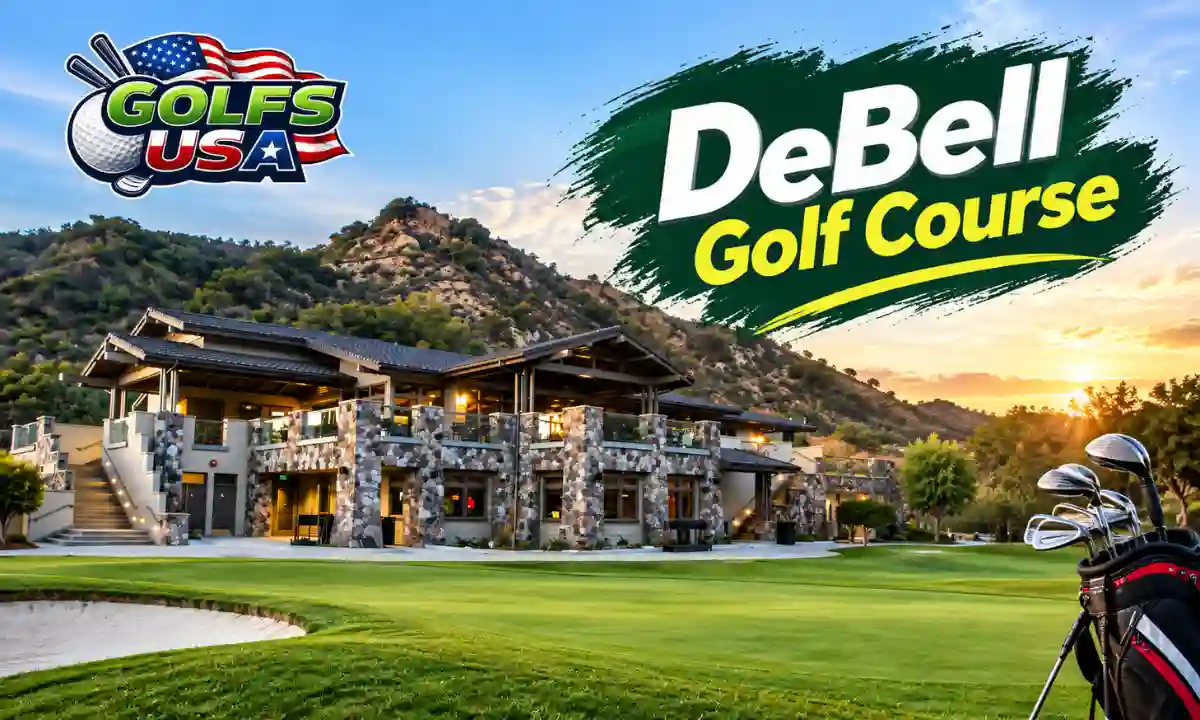
DeBell golf course is one of the publicly owned courses within Burbank, California, and it is located in the foothills of Verdugo Mountains, 15 miles north of downtown Los Angeles. It was founded in 1959 on donated land by a developer, measures up to 5,600 yards with a rating of par 71, and it costs $46 for a resident of Burbank playing on a weekday. There is a par-3 nine-hole course and also another nine-hole disc golf course in an adjacent location.
The crucial number here is not yardage; rather, it is the slope. DeBell has a 68.9 rating with a slope of 122, and this is all you need to know about the course.
The quick version
| What you want to know | The answer |
|---|---|
| Where it is | 1500 E Walnut Ave, Burbank, CA 91501, in the Verdugo foothills |
| Who owns it | The City of Burbank, with KemperSports running day-to-day operations |
| Par and length | Par 71, about 5,608 yards from the blue tees, rated 68.9 with a slope of 122 |
| Opened | 1959, on 100 acres donated by developer Joseph A. DeBell |
| Designer | William F. Bell, with William H. Johnson, and later work by Richard Bigler |
| Green fee | $46 weekday for Burbank residents, $52 for non-residents, more on weekends |
| Also on site | A nine-hole par-3 course and a nine-hole disc golf course at a separate location |
| Phone | 818-845-0022 |
| The thing people remember | Ringing the bell after the blind par 3 at the 12th |
Short on paper, not short in practice
A golfer who hasn’t played this course before sees the 5,608 yard distance and thinks he can easily play this one in a relaxing afternoon. Not the scorecard, and certainly not anyone who has played it.
The Slope Rating is the difficulty of the course for a bogey golfer relative to a scratch golfer. With a Slope Rating of 68.9, we know a scratch golfer will shoot a score close to 69, which makes sense considering the yardage. The Slope Rating of 122 means everybody else finds this course quite a bit harder than that. This is a fairly high number for this distance.
There is one main reason for this. The fairways are narrow, the ground is undulating, there are shots out of bounds left, right, and center, as well as many doglegs. You cannot overpower a hole measuring 340 yards with the landing area only as wide as a driveway. Accuracy is the test here, and the driver might just be the wrong club.
A recurring note in player reviews is that the course plays longer and harder than the card suggests. That is not golfers making excuses. It is a 68.9 rating paired with a 122 slope described in numbers.
There is no water on the course whatsoever; however, you will realize that the hills will do the same job as water would be doing elsewhere. You hit the ball on the wrong side, and it will get away from you down a slope into the bushes.
The man who gave away the land
DeBell was an individual from Southern California who developed land and contributed significantly towards charitable endeavors, owning properties even in the Verdugo foothills. This was one of the properties that the City of Burbank received for 100 acres in 1954 as a donation from him.
The City of Burbank followed suit by building further on this property and by 1956 it had accumulated approximately 1,008 acres from donations, purchasing and even through eminent domain. The construction of the 18-hole course started in 1958 while the course was opened in 1959.
This history is the reason for the price being charged. The City of Burbank is not recouping the cost incurred when acquiring the land because most of the land was acquired as a donation seventy years ago. This is why the golf course charges its cost and hence a resident junior gets to play freely during weekdays in a course 15 miles away from downtown Los Angeles.
The Bell family, and a detail almost nobody mentions
The architect behind the design of DeBell is William F. Bell, who was an important architect from California in the middle of the century, who had designed more than fifty golf courses, as well as a founding member of the American Society of Golf Course Architects. William H. Johnson assisted in his design, and Richard Bigler revised it later in the 1980s.
This is the part which very often remains unwritten. The architect who has been responsible for the long-term planning at DeBell since 2008, Forrest Richardson, mentions unusual routing skills of Bell on this hilly site, and says that the routing plans done in the Bell practice were drawn by Anna Kamp Bell initially for her husband William P. Bell and then for her son.
Drawing routings for two generations in a major American golf architecture firm during the first half of the twentieth century is a very important fact in the history of the game. This is an important fact about this course, since routing is precisely what makes DeBell work. Eighteen holes have been fitted into such hilly terrain due to some clever work in routing.
The holes that define the round
The 12th, and the bell
This was a blind par 3 that went around and over the shoulder of a mountain. The green cannot be seen from the tee. After your group plays the hole, you ring a bell that is placed near the green so that the group behind can play safely.
This is an old-fashioned system used right up to the present day in Los Angeles County. It is the one thing that everybody remembers first. Just do it. Those behind you will be grateful, and the other option is having somebody hit into your group.
The 8th
Widely Consistently regarded as the toughest hole on the entire golf course, this is a par five hole which presents great difficulty in terms of its green. In a golf course which favors playing conservatively on most holes, this hole is among those where you must truly play for the distance.
The 13th
The best par 5 of this course, according to everyone’s opinion, and that proves the great design of Bell in this land. Where the 8th hole tests your skills, the 13th rewards you if you play it correctly.
Reading the greens
Local Knowledge at DeBell is contained in just one instruction for all the new players: The greens always slope towards Burbank. You are standing on a hill and the mountains drag the ball down towards the city, regardless of whatever your eyes may be telling you about the surface. The slope is more important than the appearance of the green; you will not three putt as often if you believe this.
The surfaces are a combination of Poa annua and bentgrass, but the fairways contain Kikuyu and Bermuda grasses. The Kikuyu lifts the ball off the ground and holds on to your clubs, so expect a difference in play from bentgrass or ryegrass courses.
What it costs
| Rate | Weekday | Weekend and holidays | Worth knowing |
|---|---|---|---|
| 18 holes, Burbank resident | $46 | $56 | Requires a Resident Card, which costs $15 to $25 |
| 18 holes, non-resident | $52 | $62 | Still well under the Los Angeles area average |
| Senior, 55 and over | $39 | Not offered | Weekdays only, and a strong reason to play midweek |
| Junior, Burbank resident | Free | $20 | Resident juniors genuinely pay nothing on a weekday |
| Junior, non-resident | $8 | $25 | Among the cheapest junior golf anywhere near Los Angeles |
| Twilight, from 2:30pm | $35 | $45 | The best value if you can get out in the afternoon |
| Super twilight, from 4:30pm | $23 | $28 | Enough daylight for a full round from spring through summer |
| Cart, per rider | $17 | $17 | Twilight carts drop to $12, super twilight to $10 |
These are the rates when it is at its busiest. This program has a light program schedule during off-peak season when resident 18-holes go down into the thirties during the week.
It would be wise for you to have the Resident Card arranged before your arrival if you are from Burbank, because the Resident Card is the only way for you to enjoy resident rates, which will earn back its cost during your very first game. There is also an option for Canyon Club Membership, which comes with a free game from Monday to Thursday, reduced per-game rate, warm up bucket, and fourteen day reservations.
The par-3 course and the disc golf course
This is where there can be a lot of confusion, but it needs to be made clear that the par-3 and disc golf courses are not located at the main clubhouse; they are located at the separate location of Sunset Canyon and Harvard, south of the 18-hole course.
| What it is | Size | Adult rate | Who it is for |
|---|---|---|---|
| Par-3 course | Nine holes, 60 to 90 yards each | $6 weekday, $8 weekend | Beginners, juniors, and anyone sharpening a wedge game |
| Disc golf course | Nine holes, 2,303 feet total | $6 weekday, $8 weekend | Disc golfers of every level, on the same grounds |
| Senior rate, 55 and over | Either course | $4 weekday, $8 weekend | Cheaper than a coffee for nine holes |
| Resident junior | Either course | Free weekday, $8 weekend | The best entry point into golf in the city |
The two versions of the sport are played on the same terrain, which serves better than expected. This place features some natural hills, some mature trees, some wind and a ravine that passes right down the middle of the course, thus neither of them are played on any flat terrain.
The disc golf course was built back in July of 2012 in collaboration between the City of Burbank and Innova Champion Discs, and it is still one of very few paid disc golf courses in the area. Disc rentals, pro shops with discs, some clubs and a weekly tournament are also provided. The hours of operation are from 8am to 6:45pm with the last tee time at 5:30pm, both phone numbers: 818-845-0022, ext. 6.
What golfers actually say
Rather than selling the product, an objective assessment of the review history is far more valuable. The course garners an average rating of about 3.8 from more than 1,100 reviews, with three-quarters of players endorsing it.
| What is being rated | Score | What that reflects |
|---|---|---|
| Friendliness | 4.5 | The staff are consistently the highest-rated thing about the place |
| Amenities | 4.0 | The 2009 clubhouse, range, and shop do their job well |
| Layout | 3.9 | People respect the design even when it beats them |
| Value | 3.7 | Reasonable rather than extraordinary once non-resident rates apply |
| Pace of play | 3.6 | The common complaint, and the reason to book early or late |
| Conditions | 3.5 | The weakest score, with turf quality varying through the year |
The deal is clear and straightforward. They love the people, appreciate the golf course, and hope that it was in better condition and played faster. This is the classic municipal compromise, and for these prices they will live with it. The reviewers also point out that the course has gotten better in the last few years, which is consistent with the investments made by the city.
The clubhouse and the long-range plan
The initial clubhouse was erected in April 1970 and ultimately fell into disrepair. Burbank put the cost of replacing the clubhouse in 2006 at $8 million, and the club opened its doors January 5, 2009 in the craftsman style with a bronze golfer statue by Sheila Cavalluzzi adorning the entrance. The golf course celebrated 50 years of municipal use that summer.
Under the radar, Forrest Richardson has been putting together a master plan since 2008 with analysis provided by National Golf Foundation Consulting. This plan has involved studying tree management, bunker renovation, and green enlargement on the 18th hole, among other things, including the possible development of a practice complex with a six-hole short course, training area, and indoor swing analysis areas.
Not everything in the master plan has been constructed, and municipal planning takes municipal time. What is worth noting is that the plan is being actively made for the course rather than leaving it to slowly deteriorate, which can’t be said of many city courses.
One more thing on the yardage
It can be found measured in at least three different ways on this course. The blue tees on the scorecard are measured at 5,608 yards. The history page for the city of Bellflower itself and the management company both list 5,633 yards. The architect has listed the course at 5,800 yards.
Tees move, scorecards reprint, and numbers propagate without anyone confirming anything. The truth of the matter is that DeBell is played at around 5,600-5,650 yards off the back tees, and that the measurement is of no consequence compared to how it is played.
How it compares around Los Angeles
| Course | Area | Rough 18-hole fee | Why you would play it |
|---|---|---|---|
| DeBell | Burbank | $46 to $62 | Hill golf and real elevation change close to the studios |
| Griffith Park, Wilson and Harding | Los Feliz | Around $40 to $70 | Two full-length city courses with far more room off the tee |
| Brookside, Pasadena | Pasadena | Around $50 to $80 | Two courses by the Rose Bowl, longer and flatter than DeBell |
| Scholl Canyon | Glendale | Around $25 to $35 | A short par-3 style canyon course, the closest thing to DeBell’s terrain |
| Rancho Park | West LA | Around $45 to $75 | The busiest muni in the country, long and traditional |
If long holes and wide fairways are what you desire, then Griffith Park and Rancho Park should be your choices. You should choose DeBell for a challenging golfing experience that includes hills, scenery, and courses that force you to use your mind. If you work in either Burbank or Glendale, you won’t need any further persuasion once you realize how quickly you can get home.
Final take
The DeBell Golf Course is an excellent municipal course that suffers from an underappreciation due to the presence of a number on a scorecard. For the majority of your game, keep your driver in the bag, hit smartly, believe that the greens roll back towards Burbank, and ring the bell on 12.
It is not the best conditioned golf course in the county of Los Angeles, and no one is trying to say that. All it gives you is actual mountainous landscape, excellent routing designed in the 1950s, personnel that people love to compliment, and free golf for local children on weekdays. The developer donated this piece of land in 1954, just so a city can have something like this, and seventy years later it still does its job perfectly.
Frequently asked questions
Where is DeBell Golf Course?
At 1500 E Walnut Ave in Burbank, California, in the Verdugo Mountain foothills roughly 15 miles north of downtown Los Angeles. The par-3 and disc golf courses are at a separate site at Sunset Canyon and Harvard, south of the main course. The phone number is 818-845-0022.
How much does it cost to play DeBell?
In peak season, Burbank residents pay $46 on weekdays and $56 on weekends for 18 holes, while non-residents pay $52 and $62. Seniors 55 and over pay $39 on weekdays, twilight from 2:30pm is $35, and super twilight from 4:30pm is $23. Carts are $17 per rider. Off-peak rates are lower.
Is DeBell Golf Course hard?
Harder than its length suggests. It plays around 5,600 yards at par 71 but carries a slope of 122 against a 68.9 rating, because the fairways are narrow, the terrain moves constantly, and there are blind shots and doglegs throughout. Accuracy matters far more than distance here.
Who designed DeBell Golf Course?
William F. Bell, a founding member of the American Society of Golf Course Architects who built more than fifty courses, working with William H. Johnson. The course opened in 1959, and Richard Bigler carried out revision work in the 1980s.
Who was DeBell Golf Course named after?
Joseph A. DeBell, a Southern California developer and philanthropist who donated 100 acres of his Verdugo foothill land to the City of Burbank in 1954. The city assembled about 1,008 acres in total by 1956, and the course opened three years after that.
Does DeBell have a disc golf course?
Yes, a nine-hole course totaling 2,303 feet, opened in July 2012 through a partnership between the City of Burbank and Innova Champion Discs. It shares ground with the nine-hole par-3 course at Sunset Canyon and Harvard. Adults pay $6 on weekdays and $8 on weekends, and disc rentals are available.
Can juniors play DeBell for free?
Burbank resident juniors play the 18-hole course free on weekdays and the par-3 and disc golf courses free on weekdays as well. Weekend junior rates are $20 for residents and $25 for non-residents on the main course. A Resident Card is required to claim resident pricing.
Why do golfers ring a bell at DeBell?
Because the 12th is a blind par 3 played around a mountain shoulder, with no view of the green from the tee. Ringing the bell beside the green signals to the waiting group that the hole is clear. It is a safety measure, not a tradition for its own sake, and skipping it puts the next group at risk.
Also read about: Spokane Golf Courses: The Best Municipal Golf City in America