

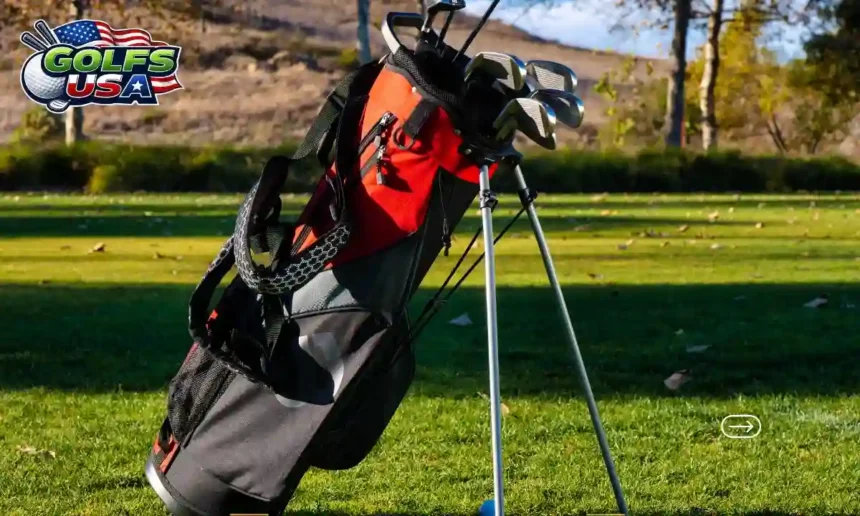
You are entitled to bring a maximum of 14 clubs in your golf bag as per the Rules of Golf. You may have fewer than 14, with no minimum, however bringing 15 or more clubs in the beginning of a round, or during the round, will get you a two-stroke penalty per hole in stroke play, which could not exceed four strokes.
This is the short answer to the question of how many clubs are allowed in a golf bag, applicable for all golfers from professional to amateurs. There are some exceptions to this rule which can be very confusing, like what counts towards 14, when you can add or substitute a club, and how the penalty is applied. This guide explains everything, along with the history of the rule, and some clever tricks to compose your own 14-club golf bag.
The Short Version
| Question | Answer |
|---|---|
| Maximum clubs allowed | 14 |
| Minimum clubs required | None. You can play with as few clubs as you like |
| Which rule covers it | Rule 4.1b of the Rules of Golf |
| Stroke play penalty | Two strokes for each hole where you broke the rule, with a maximum of four strokes |
| Match play penalty | The match score is adjusted by one hole for each hole where you broke the rule, with a maximum of two holes |
| What you must do when you notice | Take the extra club out of play straight away, before your next shot |
| Penalty for using a club taken out of play | Disqualification |
| Does the putter count? | Yes. Every club counts, including the putter |
| Can partners share clubs? | Only in partner formats like Four-Ball and Foursomes, and only if they have no more than 14 clubs between them |
What the 14-Club Rule Actually Says
Rule 4.1b states that you shall not begin play with more than fourteen clubs, nor have more than fourteen clubs during the round. All clubs are counted even if they are in a caddy’s possession or just lying in your trolley.
There is no rule as to what constitutes your 14 clubs. You can carry three putters and no driver if you wish to. The Rules are only concerned with how many clubs you carry and whether all your clubs conform to the equipment rules.
Having less than 14 clubs is perfectly acceptable. Many novice golfers play with half a set of 7 or 8 clubs, while some seasoned golfers like the challenge of a minimalist golf bag.
What Counts Toward the 14-Club Limit
Most of the time, counting to 14 is easy. A few situations are less obvious, so here is how they are treated.
| Situation | Does it count? | What you need to know |
|---|---|---|
| Your putter | Yes | The putter is a club like any other |
| A club your caddie carries for you | Yes | Every club carried by you or for you counts |
| A non-conforming club you carry but never use | Yes | It still counts toward the limit, even though there is no penalty just for carrying it |
| Parts of a broken club, such as a loose head or shaft, carried at the start of the round | No | Separated parts are not treated as clubs |
| Another player’s club you pick up after they leave it behind during the round | No | It does not count, but you must not use it |
| A club someone put in your bag without you knowing, after the round started | No | It does not count, but you must not use it |
| An extra club you realize you have just before teeing off and take out of play | No | As long as it was an accident and you clearly take it out of play before starting |
| An alignment stick or towel | No | These are not clubs, although you must not use training aids to help with a stroke during the round |
The Penalty for Carrying More Than 14 Clubs
The penalty depends on the format you are playing, and it is capped so that one mistake cannot wreck an entire round.
Stroke Play
Under the stroke play rule, one gets two penalty strokes for each hole where one used more clubs than required, but not more than four penalty strokes per round. This translates to two penalty strokes per each of the first two holes that were played using the extra club.
Match Play
Under match play conditions, the consequence is not a stroke but a reduction in your score by one hole for each hole where the violation occurred, up to a maximum of two holes.
Suppose you begin the round with 15 clubs and discover your mistake during the play of the third hole and have won that hole going three up in the match. Then the consequence is limited to a reduction of two holes, so you are only one up.
Stableford and Other Scoring Formats
The Stableford and maximum score competitions follow a similar principle. The penalty is computed based on each hole on which there was a violation, within the total cap, and will affect your score but not end your game.
How the Penalty Works in Real Rounds
The timing of when you notice the extra club changes how the penalty is applied. These examples show the most common situations in stroke play.
| What happened | Penalty | Why |
|---|---|---|
| You spot the 15th club on the first tee before hitting, and take it out of play | None | An accidental extra club taken out of play before the round starts is not a breach |
| You notice the extra club while playing the 1st hole | 2 strokes | You had too many clubs on one hole, applied at the end of that hole |
| You notice on the 3rd tee after playing two holes with 15 clubs | 4 strokes | Two strokes for each of the first two holes, which is also the maximum |
| You notice on the 10th hole after nine holes with 15 clubs | 4 strokes | The penalty is capped at four strokes, no matter how many holes you played |
| You take the extra club out of play, then use it later in the round | Disqualification | Once a club is taken out of play, making a stroke with it is not allowed |
| You knowingly bring 15 clubs to the first tee and tell your group you will not use one | The normal penalty applies | The no-penalty option before the round only covers accidental extra clubs, so declaring it does not help |
What to Do If You Find an Extra Club in Your Bag
In case you find yourself with more than 14 clubs while playing a round, it will be necessary for you to remove an additional club from the game before you make the next stroke. You can accomplish this task either by informing your marker, one of your teammates, or even your opponent if you are in a match play situation about the club you are withdrawing from the play. Other options could be clearly showing the intention to remove an additional club from the play, like turning it upside down in your golf bag, laying it down on the floor of your cart, etc.
In case there were already too many clubs at the beginning of your round, it is entirely up to you which one to withdraw from the play. In case you added one more club to the set while playing and found yourself with more than 14 clubs, it should be the added club which is withdrawn.
Count the number of holes you played with the additional club, then add the penalty stroke to your score or inform your opponent about the match adjustment in case of match play.
Adding, Replacing and Sharing Clubs During a Round
Adding Clubs
When you begin a game with less than 14 clubs, you are allowed to acquire additional clubs within the game to make up the number of 14. There is a condition attached to this that you have to complete the act without creating an undue delay to play, you are not allowed to obtain any club from another person who is playing at the same course, and you cannot construct a club using the spare parts of yourself or some other player.
Replacing a Damaged Club
A player may continue to use, repair, or replace an injured club during the game, but the replacement should not be due to deliberate abuse of the club. When the replacement of a club is made, the damaged club has to be removed from the game before the next shot. Breaking the club over one’s knee is considered abuse, and the club cannot be replaced.
Replacing a Lost Club
If you started with 14 clubs and lose one during the round, you cannot replace it. You will need to finish the round with 13.
Sharing Clubs
In case of ordinary individual play, it is not possible for you to take a stroke using a club that is being played with by any other player on the golf course. The only case where an exception applies is that of partner play, like Four-Ball or Foursomes, wherein partners can use up to 14 clubs, between them.
Why Golfers Are Limited to 14 Clubs
For nearly the entire history of the sport, however, no limit existed. This changed during the 1930s, when some players started carrying excessively large numbers of clubs. Lawson Little, a two-time winner of the U.S. Amateur title, famously carried 25 clubs at times, and studies conducted during the 1935 U.S. Open and U.S. Amateur tournaments showed that the average player had 18 or more clubs.
There were three primary reasons for implementing such a restriction. It was believed that excessive specialization robbed the game of its skill factor; secondly, such a trend favored rich people who had the means to acquire more clubs; and thirdly, the excessive weight of golf bags became too heavy for caddies to carry – some of them weighed over 30 pounds. The USGA imposed the restriction on the number of golf clubs starting from January 1, 1938, while The R&A adopted it in 1939.
There has never been any scientific justification for limiting the number of clubs to 14. It is just a reasonable number for a properly equipped golfer.
Famous Examples of the 14-Club Rule
Even the greatest players of all time have fallen prey to this rule. One such incident occurred in the 2001 Open Championship held at Royal Lytham & St Annes. Ian Woosnam was leading the game with a few other players when his caddy noticed a 15th club, an additional driver in the bag at the 2nd tee during the last round. Woosnam was penalized by two strokes and threw away the additional driver in the rough in frustration. Woosnam managed to end up with a joint third position.
This is a tip that all golfers should remember. It takes no more than ten seconds to count your clubs on the 1st tee.
How to Build a Smart 14-Club Set
Since you are allowed to pick any 14 clubs, the ideal set is the one which will close the gap in distances of your game. Golfers usually have a driver and a putter, and use the other 12 slots for woods, hybrids, and irons and wedges. Below are some examples of sets of clubs used by various golfers.
| Type of golfer | A typical setup | Why it works |
|---|---|---|
| Beginner or high handicapper | Driver, 5-wood, two hybrids, 6-iron to 9-iron, pitching wedge, sand wedge, putter, often 11 or 12 clubs in total | Hybrids are easier to hit than long irons, and fewer clubs means fewer decisions |
| Average golfer | Driver, 3-wood, hybrid, 5-iron to pitching wedge, gap wedge, sand wedge, lob wedge, putter | A balanced bag that covers long shots and gives three wedge options for scoring |
| Low handicapper | Driver, 3-wood, driving iron or hybrid, 4-iron to pitching wedge, three specialty wedges, putter | More wedges for precise distances inside 120 yards and a long iron for firm, windy conditions |
| Short hitter or senior golfer | Driver, two fairway woods, two or three hybrids, 7-iron to pitching wedge, sand wedge, putter | Higher-lofted woods and hybrids help get the ball in the air with slower swing speeds |
One method of constructing your set of clubs is to see how far each club goes. When two clubs travel about the same distance, then one is wasting space. If there is a large difference, for example between your pitching wedge and your sand wedge, then another wedge could save you more shots than another fairway wood.
Does the 14-Club Rule Apply in Casual Rounds
The Rules of Golf can be used any time one plays according to them, be it a club championship or a Saturday match between friends. In an informal game, no one would bother counting your clubs; however, if you are playing your match in order to enter your score on your handicap record, then your game should be conducted under the Rules, including the requirement of carrying no more than 14 clubs.
It is just a good practice to bring no more than 14 clubs every time you play.
Final Take
How many clubs may be put in your golf bag? The maximum number is 14, no more. If you wish, you can put fewer than 14 clubs, but if you start with a few clubs, then increase them to 14, and if you break a club without breaking it on purpose during the course of the game, then you can replace it with another one. If you have 15 or more clubs, then you could receive up to four penalty strokes for stroke play and a two-hole penalty for match play.
Frequently Asked Questions
What happens if you have 15 clubs in your bag?
If you have 15 clubs in your bag during a round, you get two penalty strokes for each hole where you had the extra club, up to a maximum of four strokes in stroke play. In match play, the match score is adjusted by up to two holes, and you must take the extra club out of play immediately.
Can you carry fewer than 14 clubs?
Yes. There is no minimum number of clubs in golf, so you can play with as few clubs as you like. If you start with fewer than 14, you can add clubs during the round up to the limit.
Does a putter count as one of your 14 clubs?
Yes, a putter counts as one of your 14 clubs. Every club you carry, or that is carried for you, counts toward the limit.
When did the 14-club rule start?
The 14-club rule started in the United States on January 1, 1938, when the USGA introduced the limit. The R&A adopted the same limit in 1939.
Can you replace a broken club during a round?
You can replace a club damaged during a round, as long as you did not damage it through abuse. You must take the damaged club out of play before making your next stroke.
Can you borrow a club from another golfer?
No, you cannot borrow or use a club from anyone else playing on the course, even if they are in a different group. Partners in Four-Ball and Foursomes can share clubs if they have no more than 14 clubs between them.
How many clubs do pro golfers carry?
Professional golfers carry the same maximum of 14 clubs as everyone else. Most tour players use all 14 spots, often swapping clubs in and out between rounds to suit the course and conditions.
Also read about: Who Makes Kirkland Golf Balls? The Factories Behind Costco’s Golf Ball, Explained