

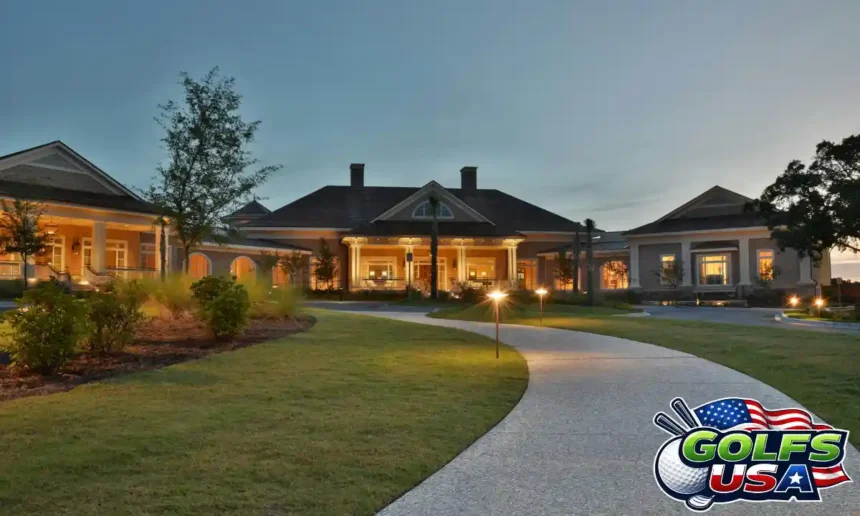
The Streamsong Golf Resort is located in a 7,000 acre plot of land reclaimed from mining phosphate in Polk County in Florida, 90 minutes drive from Tampa and Orlando. The sand dunes which you see are not natural but a result of a century’s worth of mining and four of the finest architects of the modern game have laid out their courses on them.
Red opened in December 2012, designed by Coore & Crenshaw, Blue at the same time, designed by Tom Doak, Black in 2017 by Gil Hanse & Jim Wagner and The Chain, an 18-hole short course, in 2023. The fifth course, Bone Valley, designed by David McLay Kidd is expected to open preview play on October 30, 2026, and a grand opening on January 26, 2027.
The quick version
Here is everything you would want settled before booking a trip, gathered in one place.
| What you want to know | The answer |
|---|---|
| Where it is | Rural Polk County, Florida, roughly 90 minutes from Tampa or Orlando |
| What the land was | A phosphate mine, with the dunes formed from mining spoil |
| How many courses | Three full 18s, plus a 19-hole short course, with a fourth 18 opening now |
| Who designed them | Coore and Crenshaw, Tom Doak, Hanse and Wagner, and David McLay Kidd |
| Green fee range | About $170 in summer to $445 at peak for a day guest |
| Who owns it | KemperSports, which bought it from Mosaic for $160 million in January 2023 |
| Can you play without staying | Yes, but day guests pay more and get worse access to tee times |
| The catch nobody mentions | From December 24 to February 28 the courses are walking only |
| Why it matters | Few places anywhere let you play this many great architects in one trip |
What the land actually is
This is what makes Streamsong unique to all other resorts in Florida, and the first thing about the history that everyone gets wrong.
For much of the past 50 million years, Central Florida was under water. Marine life was preserved in the sediments until, around 10 to 15 million years ago, they formed the huge phosphate rock formations. These deposits were discovered at the end of the 19th century and became the main industry in the area for more than a hundred years. The area became known as the Bone Valley, as the deposits contain some of the richest fossil sites in North America.
Mining produces sand. Lots of it. Piles of sand built up into hills and basins by draglines for decades. At the end of 2012, the company which was engaged in phosphate mining and owned the lands, The Mosaic Company, decided to construct a golf resort on the former mine site as an example of reclaimed mining land.
So the dunes are not links land and they are not natural. They are industrial waste, reshaped by people who understood golf. That is genuinely unusual, and it is why the ground here moves in ways nothing else in Florida does.
Mosaic recently sold the resort in January 2023 for $160 million to Lone Windmill LLC, a subsidiary of KemperSports, who had been managing the golf course since its opening. This transaction encompassed approximately 7,000 acres of land, the golf courses, two clubhouses, and a 228-room lodge. Most of the money was raised by Lorenzo and Frank Fertitta, who had purchased Kemper the year before. Mosaic explained that their intention was always to locate a permanent owner of the resort.
Four courses or five, and why sources disagree:
Streamsong is talked about as being either a resort with three golf courses, four, or even five, and all of them have their own merits.
This is what there really is at Streamsong and how each one gets its count.
| Course | Architect | Opened | How it gets counted |
|---|---|---|---|
| Red | Coore and Crenshaw | December 2012 | A full 18, counted by everyone |
| Blue | Tom Doak | December 2012 | A full 18, counted by everyone |
| Black | Hanse and Wagner | 2017 | A full 18, counted by everyone |
| The Chain | Coore and Crenshaw | 2023 | A 19-hole short course, counted by the resort |
| Bone Valley | David McLay Kidd | Preview from late 2026 | The fourth full 18, or the fifth course overall |
The resort pitches Bone Valley as their fifth course because The Chain is counted. Golf columnists refer to it as the fourth 18-hole course, which is technically right. A page that claims three courses means it was written prior to 2023.
Bone Valley, the one opening now
David McLay Kidd is the architect responsible for Bandon Dunes, the course that pioneered the concept of remote destination courses. Getting Kidd at Streamsong creates a foursome that is about as close to being unrivaled as any.
Streamsong has touted the property as the only location in the world that has original designs from Coore and Crenshaw, Tom Doak, and Hanse and Wagner on the same land. By bringing Kidd into the fold, you have all four of the preeminent minimalist architects under the same 7,000-acre roof.
The name itself defies convention in its own way. The three previous 18-hole courses were each named after a color, and people were expecting the fourth to be another color. The resort, instead, gave us the name for the phosphate region. KemperSports CEO Steve Skinner said it was the perfect name for a course that took literally millions of years to form.
This is no marketing fluff. Fossils were found during the construction process, including those of megalodon sharks that once roamed these oceans, along with those of large sea turtles and manatee-like animals. Kidd has said he became less amazed after the initial findings. A jaw of a megalodon shark is on show in the main lodge building, and even the logo of the golf course features the skeletal form of the animal and not colors.
In terms of its design, the routing goes over ridges, natural bowls, and the shifting sands, while its early reviews speak about it being spacious and rugged. Construction began approximately two years prior to the course’s announcement in March 2026. The preview round play was scheduled for October 30, 2026, and the grand opening is scheduled for January 26, 2027, and thus any reader who is checking this out now will have the course which hasn’t been reviewed yet.
The three established courses
Both Red and Blue have a common clubhouse and are next to one another, and what is unique about this is that the design and creation of two such great companies at the same time on the same piece of ground is unusual for golf architecture.
These are the numbers off the back tees for each one.
| Course | Par | Back tee | Rating | Slope | What it is known for |
|---|---|---|---|---|---|
| Red | 72 | 7,110 yards | 74.1 | 137 | Tighter driving lines with gentler greens |
| Blue | 72 | 7,276 yards | 74.0 | 134 | Wide fairways that pinch in near the greens |
| Black | 73 | 7,320 yards | 74.7 | 135 | Enormous contoured greens and bold bunkering |
Red, by Coore and Crenshaw
The more strategic of the two. Driving lanes are narrower compared to those on Blue, but the greens do not test your mettle like at Blue after you reach them. The back nine is tougher, especially the 12th hole that plays into the prevailing winds at about 500 yards off the back tee.
Blue, by Tom Doak
Designed to play like links and heathland golf, featuring wide fairways that get narrower the closer you get to the green. The hole everyone photographs is hole number seven; it is a par three hole from up high off a dune through water and sand. The greens are much steeper than the Red Course.
Black, by Gil Hanse and Jim Wagner
It is located about one mile away from the other two courses and comes with its own clubhouse; it is the course that causes the most division. The greens are massive and have a lot of contour; they are so big that some of the holes even have sprinklers in the greens. The 9th hole with the windmill and the massive punchbowl green makes up for this course, and the 18th is a true risk reward par 5 with hazards and deep bunkers on the green.
Black receives excellent scores for everything except the cost and the fact that the greens can be really hard on beginners. The caddie is especially necessary on this course compared to the others on the property.
The Chain, and why it is not a normal short course
The Chain opened for preview play on December 1, 2023 and represents the most exciting non-18 hole course at the resort.
The Chain is a 19 hole layout with no par and no tee markers; however, the large dragline chains that remain from the mining operation delineate an area where players can choose their own preferred tees in a match, each winning player choosing his own tee for the following hole. Thus, it is a complete negotiating process.
A player can go to six holes, to 13 holes or to 19 holes; lengths of holes vary from approximately 50 yards for the shortest one to 293 yards for the 8th. The 11th requires a carry of 150 yards over water into a large punchbowl green – this is the hole everyone discusses after the game.
This 36-acre layout in front of the lodge is walking only and available to resort guests only, and the first six holes, called The Link, are complimentary to resort guests. This makes it the most interesting golf free of charge in the state.
Two putting courses, which confuses people
Streamsong has two separate putting courses and they get mixed up constantly, so it is worth being clear about which is which.
| Which one | Where it is | Who built it | What it is |
|---|---|---|---|
| The Gauntlet | At the Black clubhouse | Gil Hanse, 2017 | An 18-hole putting course running about 844 yards |
| The Bucket | By the lodge, within The Chain | Coore and Crenshaw | Two acres built around a 22,000-pound dragline bucket |
The Bucket is the one with the piece of mining equipment sitting in the middle of it, which is as direct a statement of what this place used to be as anything on the property.
What it costs, and when to go
Pricing swings more than almost any resort in American golf, and the difference between booking well and booking badly is more than double the green fee.
| When you play | Resort guest | Day guest | What is going on |
|---|---|---|---|
| June 24 to September 14 | $170 | $170 to $220 | Florida summer, which is hot but genuinely cheap |
| May 23 to June 23 | $190 | $240 | The best value window before the heat arrives |
| May 1 to May 22 | $295 | $345 | Shoulder season with good conditions |
| December 15 to January 13 | $315 | $365 | A surprising dip right in the middle of winter |
| October 1 to December 14 | $375 | $425 | Autumn, and the courses are usually at their best |
| January 14 to April 30 | $395 | $445 | Peak season, and the hardest time to get on |
Cart fees run at $35 per person additionally, and there are also rates for residents of Florida and Georgia, which can be worthwhile checking if you are one of them. The Chains cost $95 for the resort guests and $115 for the day guests, being reduced to $65 and $85 respectively during the summer months.
December 15 to January 13 is the period when most people forget about. It lies between two costly periods and reduces the resort guest fee by $80.
The walking rule that can wreck a trip
It’s the one most crucial practical detail on this page, and it’s buried on the fees page where nobody ever looks.
There are carts available from March 1st until December 23rd. From December 24th until February 28th, all courses are walk only. There are no carts available in that timeframe regardless of what you are willing to pay.
That’s not all. Every tee time before 8AM is limited to foursomes and involves walking caddie or group caddie service. The early morning twosome in January, complete with a cart is no longer an option.
The cost of a caddie service is determined by the caddies and paid to them directly. Walking caddies with two bags costs around $120 per player, plus tip; with one bag costs around $150 per player, plus tip. Group caddie service costs about $60 per player, plus tip.
All of the above is not a criticism of the resort. Streamsong is all about walking and advertises itself accordingly. But a group booking a late December trip expecting to get carts will be surprised at the check-in and the courses are long.
Is it worth it
For someone who cares about architecture, there are probably two or three courses worth traveling to in the country, and Streamsong is one of them, because of concentration. Going to Coore and Crenshaw, Doak and Hanse in the same week, on the same ground, in the same conditions is an experience that you cannot get elsewhere. Including Kidd makes it even better.
It is not a family vacation spot and it is definitely not convenient to travel there. You are an hour and a half from either of the airports without any infrastructure around, it is tough to play golf there and the greens at Black are not forgiving if you don’t know your stuff. No houses, no neighbors and no activities within a reasonable reach – that’s the whole idea for some but a showstopper for others.
The problem of value totally depends on timing. It will cost $445 in February and it might be hard to justify that cost against other high-end resort destinations in America. In July it will be $170 with heat being the only negative factor.
Final take
The Streamsong Golf Resort succeeds because one person thought of sand dunes when he or she saw a mined phosphate mine. Everything wonderful about this resort is because of that choice, even the unique way in which the land shifts here. Come during late spring or early summer if money is a consideration; during fall if conditions are most important to you; and be aware of the cart policy during December until the last week of February. Get a caddie for the Black course, and if you’re coming next year, then Bone Valley will be the course you are most asked about.
Frequently asked questions
Where is Streamsong Golf Resort?
In rural Polk County, Florida, roughly 90 minutes from both Tampa and Orlando. It sits on about 7,000 acres of former phosphate mining land with no town nearby, which is why nearly everyone who plays there stays on property.
How many golf courses does Streamsong have?
Three full 18-hole courses, Red, Blue and Black, plus The Chain, a 19-hole short course. Bone Valley, a fourth 18 by David McLay Kidd, was announced to begin preview play on October 30, 2026 with a grand opening on January 26, 2027. The resort counts Bone Valley as its fifth course because The Chain is included.
Who designed the Streamsong courses?
Bill Coore and Ben Crenshaw designed Red and The Chain, Tom Doak designed Blue, Gil Hanse and Jim Wagner designed Black, and David McLay Kidd designed Bone Valley. The resort has described itself as the only place on Earth with original designs by the first three on one property.
Was Streamsong really built on a phosphate mine?
Yes. The land was mined for phosphate rock, and the sand ridges the courses run across are mining spoil rather than natural dunes. Mosaic, the phosphate company that owned the land, developed the resort from 2012 as a demonstration that mined-out land could be reclaimed into something productive.
How much does it cost to play Streamsong?
Resort guests pay between $170 in summer and $395 at peak season, while day guests pay roughly $170 to $445. Carts add $35 per person and caddies are paid directly, starting around $60 per player for a group caddie. The Chain costs $95 for resort guests and $115 for day guests.
Can you play Streamsong without staying there?
Yes. Day guests can book, though they pay $50 or so more per round and generally get less favorable access to tee times than resort guests. Given the distance from Tampa and Orlando and the lack of anything nearby, most visitors stay on site anyway.
Do you have to walk at Streamsong?
Sometimes, yes. Carts are available from March 1 to December 23, but from December 24 through February 28 every course is walking only with no exceptions. Any tee time before 8am is also limited to foursomes and requires a walking or group caddie. The Chain is walking only year round.
Which Streamsong course is the best?
There is no settled answer, which is part of the appeal. Red and Blue are frequently described as too close to separate, with Red offering tighter driving and gentler greens and Blue offering wider fairways and more severe putting surfaces. Black is the most dramatic and the most divisive, mainly because of the size and contour of its greens.
What is The Chain at Streamsong?
A 19-hole short course by Coore and Crenshaw with no par and no tee markers. Dragline chains left over from the mining operation mark suggested teeing areas and you choose where to play from. You can play six, 13 or all 19 holes, and in a match the winner of each hole selects the next tee. The first six holes are free for resort guests.
Who owns Streamsong Resort?
KemperSports, through a subsidiary called Lone Windmill LLC, which bought it from Mosaic for $160 million in January 2023. Kemper had already operated the golf business since the first courses opened in December 2012, so the sale handed the resort to a company that already knew it.
Also read about: Quintero Golf Club: The $100 Million Failure That Became Arizona’s Best Public Course