

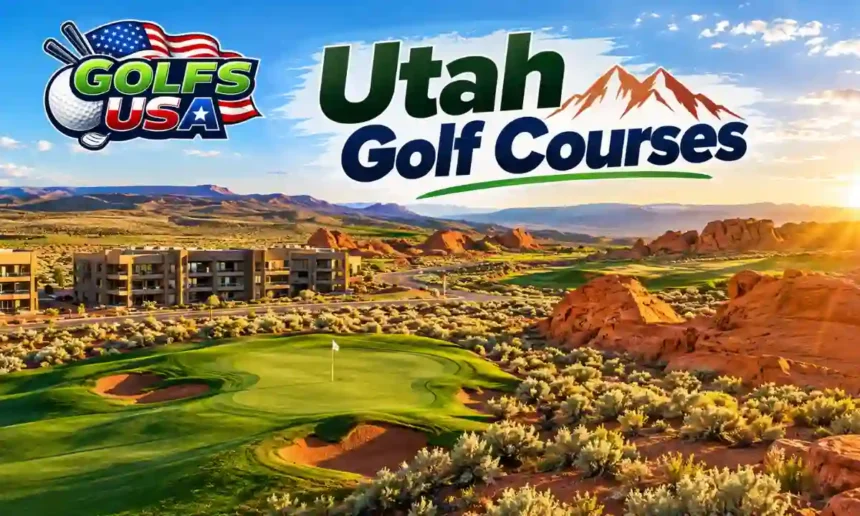
Utah is home to about 114 golf courses, and about 57 percent of these courses are partially owned by the public. This second figure accounts for almost everything unique about golf in Utah, as course fees in the range of $40 to $80 per round with a cart is only about half the price of similar courses in other states.
The more important statistic is geographic, as Utah golf courses have elevations from 2,800 feet near St. George to 7,000 feet in the vicinity of Park City. It is because of this difference in elevation that Utah essentially has two distinct golf seasons with very little crossover, and knowing the distinction will make or break a Utah golf vacation.
The quick version
| What you want to know | The answer |
|---|---|
| How many courses | Around 114 statewide, with about 57 percent at least partly publicly owned |
| Typical green fee | $40 to $80 for 18 holes with a cart at public courses, lower at municipals |
| The two regions | St. George in the southwest and the Wasatch Front and Back in the north |
| Winter golf | St. George plays year round, northern Utah is largely shut from roughly November |
| The best-known course | Sand Hollow Resort Championship in Hurricane, a John Fought design from 2008 |
| The newest big name | Black Desert Resort in Ivins, Tom Weiskopf’s final design |
| PGA Tour event | The Bank of Utah Championship, held at Black Desert each October since 2024 |
| The quirk worth planning around | In spring you can ski in the morning and play 18 in the afternoon |
The I-15 split, and why it decides your trip
Almost all that has been written about golfing in this state refers to it as one destination. This is not the case, for the two golfing destinations are four hours away from one another via I-15, they experience different peak seasons, and they are nothing alike.
| Region | Elevation | Peak season | What the golf looks like |
|---|---|---|---|
| St. George and Greater Zion | Around 2,800 to 3,300 feet | Autumn through spring | Red sandstone, black lava fields, desert washes |
| Salt Lake and Utah Valley | Around 4,300 to 5,000 feet | April through October | Valley parkland and bench courses against the Wasatch |
| Heber, Midway and Park City | Around 5,600 to 7,000 feet | Late May through September | Mountain golf, aspens, serious elevation change |
St. George is located in the far southwestern part of the state, two hours to the north of Las Vegas and adjacent to Zion National Park. The area receives 300 days of sunshine annually and even plays golf in the wintertime. When northern Utah is covered with snow, this is where the state plays its golf.
The opposite holds true for the northern part of the state. Golf courses that lie in mountain resorts such as Midway and Park City are cool and lush in July when St. George is hot beyond belief and out of play well into the fall season.
The practical rule: book the south between October and April, book the north between June and September. A trip in late spring or early autumn can catch both, which is the one window where a visitor can play the whole state in a week.
What altitude does to your golf ball
And this is what the majority of visitors tend to underestimate because there are plenty of elevation differences all over Utah, and depending on where in the state you go, the difference will be pretty significant.
With thinner air, there will be less resistance, and therefore, the ball will fly further. The rough estimate would be an additional 1.5 to 2 percent per 1,000 feet of altitude. In St. George, when it is about 2,800 feet above sea level, it will not be a huge difference but noticeable. In Soldier Hollow, or Wasatch Mountain with its 6,000 feet altitude, we will have an additional 10 percent of carry distance, which means about one club for any golfer, and more than that if there is a high trajectory.
| Where you are playing | Rough elevation | Approximate carry gain | What it means in practice |
|---|---|---|---|
| St. George area | About 2,800 to 3,300 feet | Around 5 to 6 percent | Half a club, and easy to miss on a warm day |
| Salt Lake Valley | About 4,300 to 5,000 feet | Around 8 percent | Close to a full club on longer irons |
| Heber and Midway | About 5,600 to 6,000 feet | Around 10 percent | A full club, sometimes more into an elevated green |
| Park City courses | Up to about 7,000 feet | Around 12 percent | One to two clubs, and the main reason visitors fly greens |
First, be aware that temperature and moisture content play a part in carry, so a cool day at 6,000 feet will carry less distance than a hot one at the same altitude. Second, altitude favors carry over roll, so two holes played from the same stated distance, one on the hill and one in the desert, are two very different propositions.
It makes sense to use a slightly lower club for the first shot on the course in the mountains, wait a few shots, and adjust accordingly, rather than relying on the rangefinder numbers that you’ve been using all year long at sea level.
Ski in the morning, golf in the afternoon
This is truly a “Utah thing” and not one of those “come and play here” slogans made up by the tourism board, and it works due to the high density of ski resorts and valley courses.
More than 40 public courses exist within 1-hour drive from six Cottonwood/Park City ski resorts, and most of them are located within 30 minutes. Near Snowbasin resort, in Ogden, there are about ten public golf courses within 30 minutes distance. There are five golf courses around Sundance with one in Heber Valley and another one in Provo.
The season is spring. All ski resorts in Utah close between mid and late April, with Snowbird Resort closing even later, sometimes stretching out the season into May. The spring snow is at its best early in the morning when it is hard, and tee sheets at the more popular courses will loosen up in the afternoon, so the sequence of events falls into place itself. There are half-day tickets sold at a few resorts due to the same reason.
However, there is one little thing that nobody talks about – the valley courses in late March/early April can still be quite soft.
Black Desert and the PGA Tour
Utah golf’s biggest newsworthy occurrence in decades can be found in Ivins, near St. George, where the Black Desert Resort recently opened and now plays host to an annual PGA Tour event in October.
This golf course was designed by Tom Weiskopf. He passed away in August 2022, some four months before the course opened; it was then finished based on the initial design plans he had created, and done by Phil Smith, his design partner at the time. Smith has said that it was the toughest challenge of his life to work on, and that its appearance would be something like a cross between Kona and Sedona.
It was indeed quite challenging to make. This golf course lies within basalt from a volcanic eruption some 30,000 years ago; each and every inch of usable land had to be blasted away. Black rocks lie alongside each fairway; they serve as a hazard from which there is no recovery. The convergence of three different ecosystems occurs here, the Mojave Desert, Colorado Plateau, and Great Basin.
| Detail | The fact | Why it matters |
|---|---|---|
| Designer | Tom Weiskopf with Phil Smith | Weiskopf designed more than 70 courses; this was the last |
| Tournament setup | Par 71, 7,421 yards | Eleven par 4s, four par 3s and only three par 5s |
| Turf | Bentgrass tees, fairways and greens | Unusual for southern Utah, with Kentucky bluegrass rough |
| Footprint | 600 acres, about 75 of them turf | Roughly 200 acres are set aside as conservation area |
| Water | Irrigated with gray water | A direct response to local concern during planning |
| Certification | Audubon International Signature Sanctuary | Dark-sky guidelines and a wildlife preserve on site |
This golf tournament started in 2024 as the Black Desert Championship and was rebranded as the Bank of Utah Championship in 2025 after the Ogden-based bank secured the title sponsorships for three years. Matt McCarty bagged the title in its inaugural year to notch up his maiden Tour win; Michael Brennan won in 2025 while Austin Smotherman clinched the title in 2026 with 258, 26 under being the tournament record.
Also, an LPGA event was held here in 2025, where Ryu Hae-ran won the title. However, this LPGA event was held only once, and hence, if you find Utah to have both a PGA Tour stop and an LPGA stop, it would be obsolete information.
Why the best-course lists disagree with each other
The best course in Utah has varying opinions on how it is perceived from sources that all seem credible. This explains the need to know the reason so as to avoid being misled and selecting a course from an unreliable source.
Lists compiled from the feedback of golfers like GolfPass Golfers’ Choice lists based on the amount and most recent user rating. The 2026 edition saw TalonsCove at Saratoga Springs listed first, followed by Coral Canyon, and Carbon Country Club in Helper coming in third position. Sand Hollow, Black Desert, and Soldier Hollow did not feature in this ranked list but in a separate editors’ list.
This does not indicate a better golf course than the other because of the ranking methodology in which a much favored $50 golf course can come before a $200 golf course.
| List type | What it actually measures | How to use it |
|---|---|---|
| Golfer review rankings | Satisfaction relative to price and expectation | Excellent for finding value you would not otherwise hear about |
| Architecture panels | Design quality judged by trained raters | Better for deciding which single course is worth the splurge |
| Magazine top-100 lists | A mix of design, conditioning and reputation | Useful for shortlisting, slow to recognize new courses |
| Travel site listicles | Often resort marketing with a ranking attached | Treat as a starting point, verify the specifics elsewhere |
For a Utah trip the practical answer is to use both kinds. Take the splurge round from the architecture side and fill the rest of the week from the value side, where this state is genuinely exceptional.
The courses that define each region
Sand Hollow Resort, Hurricane
The Championship Course, built by John Fought and Andy Staples and launched in 2008, is what all golfers imagine when they think about Utah. It is a par 72 that stretches to 7,315 yards from the black tees and has a 73.7 rating and slope of 131.
The first nine holes can be described as a flat desert golf course. The reputation of the course is due to holes 11 to 15, where you will play along the rim of a canyon while red rocks fall off next to you. Sand Hollow also has two other 9 hole courses, so it offers a full day play.
Entrada at Snow Canyon, St. George
Technically privately owned, but members of the Inn at Entrada may also play the course, and this is the main way to access it. Architect David McLay Kidd, who designed Bandon Dunes, finished his renovations for a total cost of about $7 million in 2022. This makes it one of the newer courses in the state.
Coral Canyon, Washington
A semi-private course that consistently rates near the top of golfer-review lists in Utah, with green fees in the $75 to $150 range. For many visitors it is the best balance in the southwest between course quality and what you actually pay.
Soldier Hollow, Midway
There are two 18-hole golf courses at the resort called Gold and Silver. Both are built on land used in 2002 as an important Winter Olympics site. This is Wasatch Mountain State Park, which means that the park is managed by an organization responsible for one of the best public golf facilities in the Mountain West region.
The Gold is the mountain course that features significant elevation gain and the back tee exceeds 7,700 yards. The Silver is the parkland course and what is special about this course is the card with par 72 including six par 3 holes, six par 4 holes and six par 5 holes. This combination of par holes is quite unusual and unique.
Wasatch Mountain, Midway
The Wasatch Mountain State Park also contains a golf course with 36 holes, namely the Lake Course, which was built in 1967, and the Mountain Course, built in 1998. The elevation is about 6,000 feet, and the summer weather is cool there. The fall colors from late September to early October are the most beautiful for golfers in Utah.
The Salt Lake municipals
Easy to overlook and the backbone of golf in the state. Mountain Dell up Parley’s Canyon, Bonneville, Glendale and the others deliver real courses at prices that have not detached from reality. If you are in Salt Lake City for work rather than golf, this is where you play.
The water question, honestly
There are no discussions about golfing in Utah that do not involve issues related to water because it is the element that will determine what kind of courses will survive in twenty years. Numbers should be known before one can believe any side completely.
Analysis in The Salt Lake Tribune received information about usage by 90 out of 114 courses. In 2022, those courses will use about 23,600 acre-feet of water, compared to 25,400 of the year before on 15,500 acres of golf course grounds, more than 24 square miles. Washington County golf courses, located in the hot part of the state, were mostly in the top ten of consumption list.
| The figure | The number | Context |
|---|---|---|
| Courses statewide | About 114 | Data was available for 90 of them |
| Water used in 2022 | About 23,600 acre-feet | Down from about 25,400 acre-feet in 2021 |
| Land under golf | About 15,500 acres | More than 24 square miles across the state |
| Courses in the lake basin | 85 | Within the Great Salt Lake drainage |
| Courses that cut use | About 40 | Between 2021 and 2022, with roughly two dozen increasing |
However, some courses have made cuts. For example, Mountain Dell of Salt Lake City has reduced their use by 284 acre-feet, while Cove View in Richfield has decreased theirs by 277. Some courses had the opposite trend, where Entrada of Snow Canyon showed the biggest rise at 137 acre-feet.
What gets lost in the debate is the issue of scale. Great Salt Lake is currently lacking approximately one million acre-feet of inflows. The unreported courses in the basin could be responsible for somewhere close to 20,000 acre-feet per year. Indeed, the Tribune itself stated that the closure of golf courses will not help the lake, a conclusion that goes against both sides in the debate – the opponents of golf as well as those claiming there is no debate to be had.
A 2024 bill sponsored by Representative Doug Welton demanding metering of golf course water use and its reporting to the public has been watered down to a research paper and failed to pass the committee. Indeed, as Welton noted, one cannot improve without the information.
Also read about: DeBell Golf Course: Burbank’s Short, Tight Muni in the Verdugo Hills
What it costs to play here
| Tier | Typical 18-hole fee | Examples and notes |
|---|---|---|
| Municipal | $30 to $50 | Salt Lake City and Ogden city courses, cart usually extra |
| State park | $55 to $90 | Soldier Hollow and Wasatch Mountain, with resident discounts |
| Public and semi-private | $40 to $80 | The broad middle, and where Utah’s value reputation comes from |
| Upper public | $75 to $150 | Coral Canyon and similar, varying sharply by season |
| Resort | $150 and up | Sand Hollow and Black Desert in peak season |
| Private | Membership only | The Park City tier, including Promontory and Victory Ranch |
Two items drive these figures more than any other. The season is the first one: a southern Utah resort course in January and the same course in July are almost different products at different prices. The residency is the second one because state parks and municipal courses charge Utah residents less than visitors, and even request verification sometimes.
The Utah PGA also publishes a book of discounts from about 80 golf courses, two of which include free rounds for two people. This will pay for itself very quickly if you plan on playing many rounds.
Final take
The reality about golf courses in Utah is not that any specific course should be on anyone’s international bucket list. What it really is, is that not many places offer the opportunity to play red rock desert golf in the winter and mountain golf at 6,000 feet in summer, while keeping prices affordable, and with the majority of courses being in public hands.
Black Desert gives the state its real tour facility and recognition. Sand Hollow provides the picture that everyone recognizes. The real reason for the golf trip to Utah, however, is the depth under those two factors, and the fact that someone who plans their trip correctly will get an opportunity to play six or seven really good and different courses at the cost of just one round of golf at a destination resort elsewhere.
Plan your trip, club down for the elevation, and figure out which half of the state you are going to.
Frequently asked questions
How many golf courses are in Utah?
Around 114 statewide. A Salt Lake Tribune analysis obtained water data for 90 of them and noted three as closed. About 57 percent of Utah courses are at least partly publicly owned, which is a high proportion by national standards and a large part of why green fees here stay low.
Can you play golf in Utah year round?
In the southwest, yes. St. George and the surrounding Greater Zion area play golf through the winter at elevations around 2,800 to 3,300 feet. Northern Utah is a different story, with valley courses typically closing from around November and mountain courses at Midway and Park City out of play for considerably longer.
What is the best public golf course in Utah?
It depends which measure you use, which is why lists disagree. On architecture and reputation, Sand Hollow Resort’s Championship Course and Black Desert Resort lead. On golfer review rankings, GolfPass Golfers’ Choice 2026 put TalonsCove at Saratoga Springs first and Coral Canyon second, with the resort courses placed in a separate editors’ section.
How much does golf cost in Utah?
Public courses generally run $40 to $80 for 18 holes with a cart, which is roughly half the equivalent in many other states. Municipals start around $30, state park courses run $55 to $90, and resort courses such as Sand Hollow and Black Desert go past $150 in peak season.
Does the ball go farther in Utah?
Yes, and noticeably so in the north. Carry increases by roughly 1.5 to 2 percent per 1,000 feet of elevation, so a course near 6,000 feet in Midway plays about 10 percent shorter in the air, which is close to a full club. In St. George at around 2,800 feet the effect is nearer five percent.
Can you really ski and golf on the same day in Utah?
Yes, in spring. More than 40 public courses sit within an hour of six Cottonwood and Park City ski areas, many under 30 minutes. Most resorts close between mid and late April, with Snowbird often running into May. Ski the morning while the snow is firm, then play in the afternoon when tee sheets open up.
Who designed Black Desert Resort?
Tom Weiskopf, with his design partner Phil Smith completing the work. It was Weiskopf’s final design; he died in August 2022, about four months before the course opened, and Smith built it to his original plans. The course was blasted out of basalt laid down by an eruption roughly 30,000 years ago.
Does Utah have a PGA Tour event?
Yes. The Bank of Utah Championship is played at Black Desert Resort in Ivins each October as part of the FedExCup Fall. It debuted in 2024 as the Black Desert Championship and was renamed in 2025. Austin Smotherman won the 2026 edition at 26 under par, a tournament record.
Are there golf courses in Utah state parks?
Yes, and they are among the best public golf in the state. Wasatch Mountain State Park in Midway contains 36 holes across its Lake and Mountain courses, plus the two Soldier Hollow courses, Gold and Silver, built on ground used as a major venue during the 2002 Winter Olympics.
When is the best time to golf in Utah?
For southern Utah, October through April, with the shoulder months best for both weather and rates. For northern Utah, June through September, with late September into early October giving the best mountain conditions and fall color. Late April into May is the narrow window that lets you combine both regions in one trip.
Also read bout: DeBell Golf Course: Burbank’s Short, Tight Muni in the Verdugo Hills